

On Beginnings (pt. 2)
And Simchat Torah

A few months ago, I wrote an essay on beginnings and my prayer to be able to return to them anew again and again because they are so full of potential. I wrote about my daughter’s beginning and the way her eyes first took in light, full of wonder and possibility.
And now, as the holiday of Simchat Torah closes this season of fall holidays on the Jewish calendar and we’re restarting the yearly cycle of reading (and sometimes chanting) the written Torah, beginnings are on my mind again.
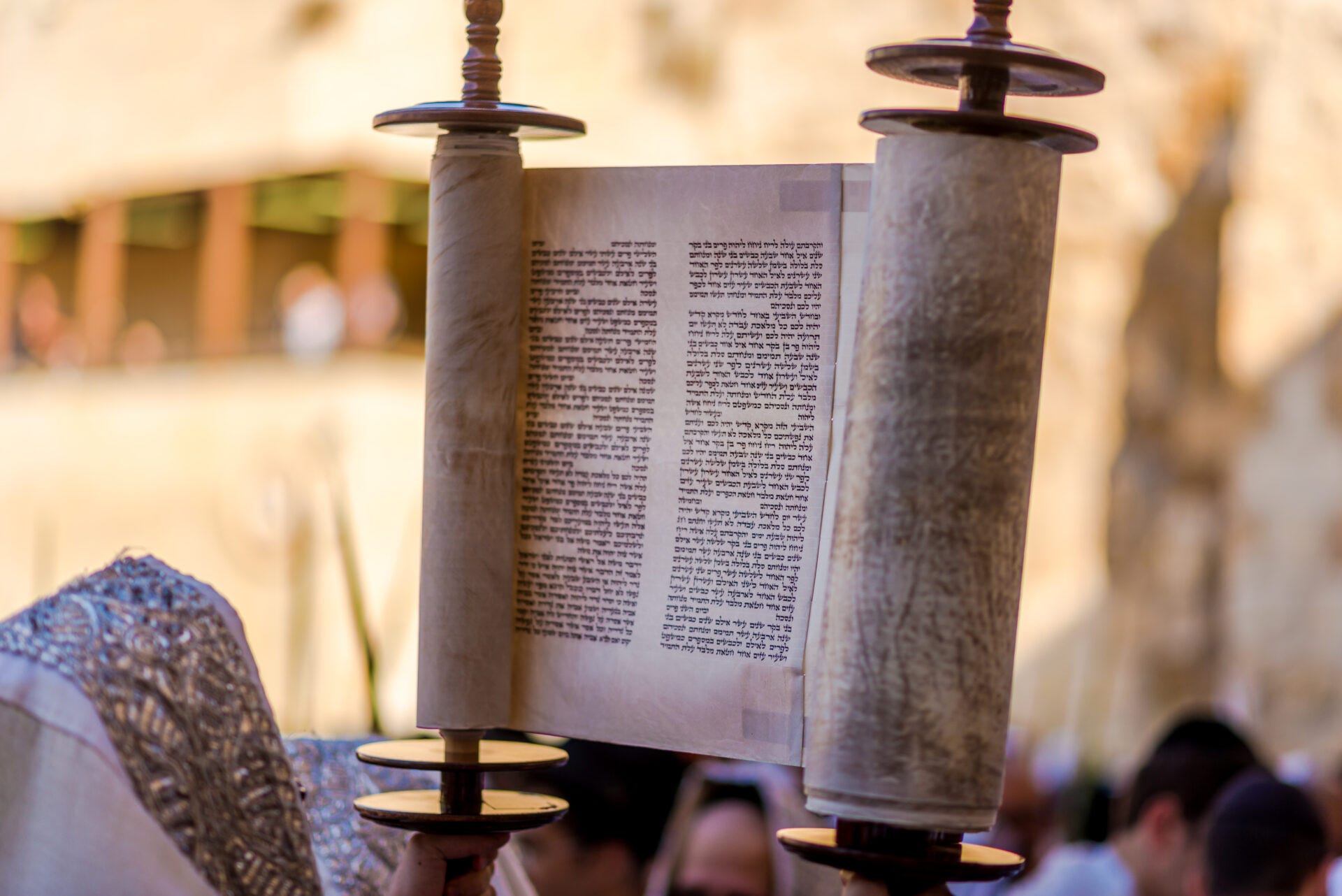
More specifically, I’m thinking about this cycle of stories we tell, what it means to end it and then immediately begin again, both in general and for this moment. This is, as Jericho Vincent calls it, the Oldest Book Club in the World, with the same long book (technically five books) that tells the story of the ancient Israelite people, their wild origins speaking to a strange divine voice, their family dramas, their descent into slavery in a distant land, their freedom, and finally the revelation of their purpose to be a blessing.
The end and the beginning
Let’s look at both where we end and where we begin. The final portion of the Torah is aptly called Vezot Habracha—”and this is the blessing”—and it culminates in a celebration of Moses. “Never again did there arise in Israel a prophet like Moses, whom God knew face to face,” the text tells us. And yet it’s worth considering who Moses has been in the books preceding. A perfect person? An unimpeachable role model? Definitely not. Indeed, again and again Moses’s flaws are highlighted—his lack of self-confidence, his occasional cowardice, his impatience, his doubt, his anger—and while we see him choose his better self in many of his trials, we also see him fail.
And still we end with the celebration of this deeply flawed messenger, with the blessing he leaves behind to the people—a final gift, his appeal to them to be like his better self and to continue the teaching that “began with the congregation of Jacob.” What makes Moses worthy of celebration is not his perfection but his willingness to keep trying, to keep confronting his fears, to keep doing the work even when he fails. This is the blessing he leaves us—not a model of perfection, but a model of perseverance in repair.
And then, immediately, without pause, we return to the beginning: Bereishit. Bereishit barah elohim et ha’shamayim v’et ha’aretz. Many translations of this famous line exist, and to the pile I humbly add my own: “Inception created divinities; the whole being of the skies and the whole being of the earth.”
This translation feels true to me because it posits that creation itself was a rupture, an inception that scattered divine sparks throughout existence. The Kabbalistic tradition teaches that these sparks of light were shattered and scattered, and the work of humanity is to gather them, to reassemble what was broken. This is not just poetic metaphor; it’s a framework for understanding our purpose. We are here to do the work of repair, of tikkun, of putting back together what has been fragmented.
On return
The Tao Te Ching offers wisdom that illuminates this practice of cyclical return. Chapter 40 teaches:
Reversal is Tao’s movement.
Yielding is Tao’s practice.
All things originate from being.
Being originates from nonbeing.
The fundamental movement of existence is not linear progress but reversal and return—coming back to the source, again and again. Chapter 16 describes this return as finding stillness:
Things grow and grow.
But each goes back to its root.
Going back to the root creates stillness.
The Jewish practice of reading Torah in an endless cycle embodies this Taoist wisdom. We don’t finish the story and move on. We finish and immediately begin again, because the work is never complete. Each return offers new insight, new sparks to gather.
Stories sparking insights
So we return, year after year, to this ancient story. But why? What happens in the return itself?
I love how George Saunders describes stories—as machines that roll along and spark off insights as they go. The Torah is no different. It’s an ancient machine, worn smooth by millennia of hands turning its wheels, and yet each revolution creates new light, new understanding. The question is not whether the story is “true” in some historical sense, but what insights spark off for us this year, in this moment, as we engage with it anew.
For me, this year, what sparks off is the most repeated commandment in the entire Torah—appearing six distinct times (though according to the Babylonian Talmud, the commandment actually comes up thirty-six, and some say forty-six times in various ways). More than keeping Shabbat, more than any dietary law, more than even loving God: “Love the stranger, for you were strangers in the land of Egypt.”
Moses’s example
This is what Moses understood. This is the work of reassembling the scattered sparks. The most heroic thing a person can do is confront their greatest fears—as Moses did when he returned to Egypt, when he spoke despite his stammer, when he led a people through wilderness. And then, once our fears are overcome, the work becomes not only to spread liberation but to organize life after liberation to be a blessing. That’s why the final chapter is Moses’s blessing to the people. He modeled the work, and then blessed us to continue it.
Loving the stranger is the core of that work. It’s the commandment that echoes through the entire cycle, from the moment we leave Egypt until Moses’s final words. And it’s the commandment that requires the most courage, because the stranger represents our greatest fears—the unknown, the other, the one we don’t yet understand.
The work before us
Which brings us to this Simchat Torah, two years after the Simchat Torah that fell on October 7, 2023, when a cycle of violence and bloodshed the likes of which I had only read or heard about was unleashed in a land to which I feel deep spiritual connection—a land at the heart of this story we tell.
I have mostly not written explicitly about the war, not because I don’t have thoughts and feelings, but because I think there are those who already articulate what I think and feel as well or better than I might. Writers and activists like Aziz Abu Sarah, Maoz Inon, Elad Nehorai, and Etgar Keret; religious and spiritual leaders like Amichai Lau-Lavie, Jericho, Donniel Hartman and Yossi Klein Halevi, and Sharon Brous; organizations like Standing Together. In the early days of the war, it felt like the world was descending into an intractable story of extremes with no space for nuance. Now, a camp with growing political power has emerged that does not blink from either the pain and fear of Israelis or the devastation and grief and fear of Palestinians; it rallies for a reckoning that will lead to peace. As the tenuous ceasefire holds for now with hostages home and prisoners freed, I pray that from this camp will emerge the leaders of the next beginning that may now have some chance to see light.
Loving the stranger is not abstract this year. In that land where two peoples too often experience each other as strangers, where fear and grief have calcified into violence, where the work of repair seems impossibly distant—and in this land, the US, where a campaign of state violence has been unleashed under the pretext of “protection” from strangers immigrating from other lands—the Torah’s central commandment becomes urgent and immediate. The work of repair demands that we hold the pain on all sides without blinking, that we refuse the easy stories that deny any group its humanity, that we stand for those who can’t stand for themselves, that we insist on seeing the stranger and remembering: we too were strangers.
We read the story again. We begin again. Bereishit. Inception. The sparks scattered, waiting for us to do the work of reassembly, the work of love, the work of seeing the stranger and remembering we too know what it means to be cast out, to wander, to fear, to grieve.
May this turning of the cycle bring new light, a beginning that defies the cynicism and fear of the world as it seems right now. May we gather sparks. May we bless each other as Moses blessed the people—with the knowledge that the work continues long after we are gone, and that our small part in it matters infinitely.
Cited or Referenced:
Rav Jericho Vincent’s Instagram, where they publish weekly writings on “The Oldest Book Club in the World”
The six distinct instances of “love the stranger” commanded:
Oneness once again.....the stranger is just another version of ourselves. But we can't accept the stranger until we fully accept ourseves.
This is beautiful and so necessary today. I love your translation of the start of Bereshit. In our present day in which hate and suspicion seem to rule our media and our politics. I pray for a new civic consciousness of love and respect across boundaries, religions, and politics. Thank you Daniel for putting this forth for Simchat Torah