

On Sukkot
And the architecture of porousness

This Sukkot has fallen one year after the week my mom spent in the hospital before she died. I’ve spent the holiday thinking about boundaries—those between life and death, life and other life, life and the natural world—and how they blur and become porous in ways we don’t always acknowledge.
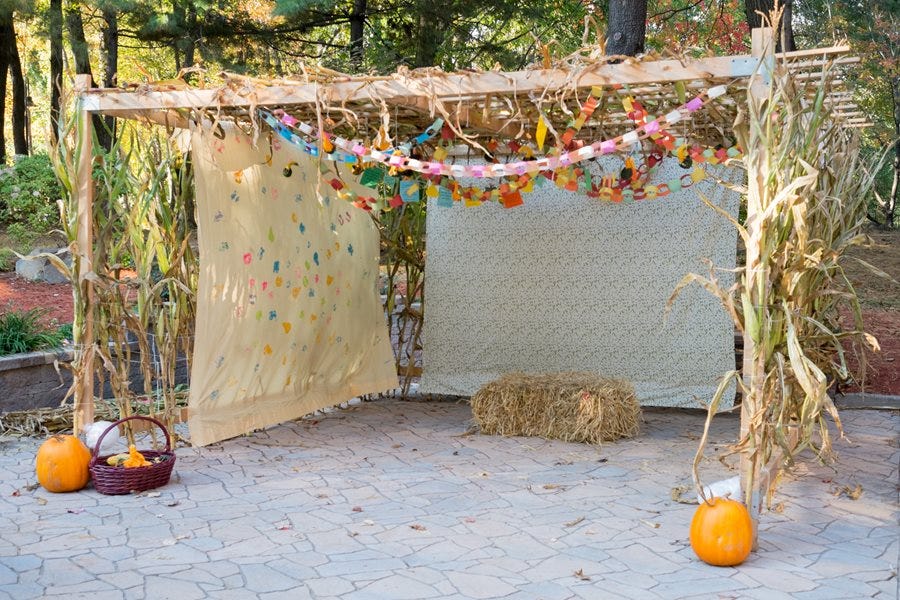
The sukkah itself is a manifestation of this. We build these temporary huts with walls that let the wind through and an open door inviting to guests and roofs with enough slates and holes in the schach (literally “thatch,” often bamboo) to see stars. For a week, we live with the boundary between inside and outside deliberately broken, eating and sleeping and celebrating in structures that we’ve purposefully built to not fully contain us.
This resonates with something the pandemic taught me: we are not as contained in our bodies as I’d previously thought. The six-foot distancing rule—that approximate math of viral spread—revealed how much our sense of being discrete, separate beings is a necessary fiction for daily life. At the edges, on the margins, we bleed (not literally, but almost) into each other. During a pandemic, this porousness was frightening. The rest of the time, I find it comforting, even beautiful.
I spend a lot of time thinking about Oneness—my approximation in language for the truth of Being, that everything is connected in a vast collective soul (don’t snooze on this scene from I Heart Huckabees). Usually when I think about Oneness, I take a two-step approach. I remind myself that I am part of it and that it lives in me, that my holy spark is one of the shards of creation. And then I remind myself that just as I am part of it, you—another person, wholly separate from me—are also part of the same Oneness, which lives fully in you. We are fundamentally different and yet the same sameness inhabits us both. This paradox complicates Oneness in what feels like an energizing way. It reminds me that in both myself and others exists the whole of existence, and so we should treat every person, as the Talmud teaches, as an entire world.
Sukkot adds a wrinkle to this understanding. The holiday suggests that on the margins, at the edges, even our literal and physical separation gets fuzzier, murkier, and maybe even ceases to exist.
We also practice ushpizin during Sukkot—inviting our ancestors into the sukkah as honored guests. Each night, we symbolically welcome figures like Abraham, Moses, and Miriam, along with our own departed loved ones, into our fragile booths. We share the space with both the living and the dead, acknowledging that the boundary between these states is more permeable than we usually admit.
So we build these little huts. We inhabit the broken boundary between our bodies and the natural world. We invite in our friends and neighbors and share this closeness with the living. We invite in our ancestors and share space with the departed.
Rav Jericho Vincent, who renews the ancient core of Jewish wisdom through what they call ‘The Ivri Way’ (among many other insights), teaches that ‘Ivri’ means ‘boundary crosser. How very Sukkot, which invites us to spend eight days focusing our attention on our physical and spiritual porousness. This is not peripheral to Jewish practice; it’s essential flint for sparking the ancient flame of Living Torah.
What an amazing holiday. Chag Sameach!
In so many ways we ARE each other. I was with my wife, the mother of my children, for 50 years. We were no longer separate but were intertwined in every way. While her physical presence is gone we are still one and she is still here. My parents are still here. Even though gone for decades they are still here. The boundaries are imaginary
Thank you Daniel.
Great essay! I find Oneness is easier to grasp when we remember we are not only these flesh and blood bodies, but beings of light and frequency, temporarily housed in these physical bodies.