

On Yom Kippur
And some questions about extremism

Recently, Ginny and I watched—over the course of two weeks—the two-part, five-hour documentary about the life and career of Billy Joel on HBO. It’s a fascinating retrospective on the piano man (I recommend!) and quite exhaustive. What’s on my mind as we move toward Yom Kippur is the story of his German-Jewish grandparents being expelled from their successful textile business by the Nazis, who then used it to produce the infamous striped uniforms of the concentration camps.
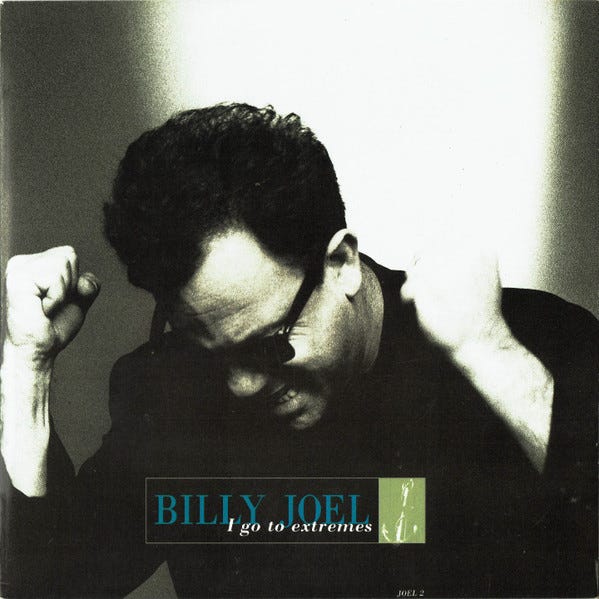
There’s a relationship, I think, between Joel’s heritage and a song of his that happens to be one of my favorites—1989’s “I Go To Extremes,” which presaged Joel’s divorce from Christie Brinkley because of his alcoholism (as I learned in the documentary). Here’s the chorus:
Darling I don’t know why I go to extremes.
Too high or too low, there ain’t no in betweens.
And if I stand or I fall, it would mean nothing at all,
Darling, I don’t know why I go to extremes.
A Yom Kippur prompt if there ever was one. The extremes of history and the extremes of personal struggle may seem worlds apart, but they reveal something fundamental about the human condition—our tendency to swing between poles rather than find sustainable middle ground. Why do we go to extremes? Does it actually mean nothing at all if one person stands or falls?
Internal extremism
I once heard Krista Tippett, creator of On Being, say that “what’s happening in the individual heart and mind and body doesn’t just matter, it’s what’s actually moving history.” It struck me as one of those statements that’s immediately, obviously true, and yet still so difficult to remember as we try to make sense of the world.
Much has been written and continues to be written about the way extreme polarization and rhetoric in our culture is contributing to an environment of dehumanization and violence. I’m not sure I have much more to add here on the level of cultural phenomena. I’m more interested at the moment in thinking smaller. Specifically, I’m considering how extremism happens in the individual heart, mind, and body.
What I think I see is how our culture picks again and again at the scabs of early hurt we all carry. With the relentless barrage of media and social media on the individual psyche, it’s almost impossible to imagine how those scabs wouldn’t get picked—someone, somewhere has a take or a response or even just a wayward thought that will, for reasons specific to you, trigger you and rip open your scars. It’s inevitable. And it’s not just that this picking of scabs unlocks our internal extremism, but that we spend so much time inside this barrage that we remain trapped in the emotional intensity of our open wounds for sustained periods, flailing about, unable to return to a more balanced state of mind.
I’ve felt so certain that this penchant we have for extremism, and the way so much of today’s technology and rhetoric is designed to push us there, is THE problem of our time, that the solution has seemed equally clear—if only we could excise extremism completely!
And yet, and yet, and yet. I feel compelled to investigate this certainty. To unknot it. Untying certainties is one of the core projects I’ve made for myself with this newsletter. So what happens when this notion I’ve grasped tightly gets loose?
Is there really no value in extremism of any kind? In the face of extreme injustice and violence, is not extreme opposition to that injustice and violence warranted? Consider Martin Luther King Jr. ‘s philosophy of radical nonviolence. King held an uncompromising, total commitment to love in the face of hatred, to peaceful resistance against violent oppression. Is this kind of disciplined, principled, and ultimately transformative adherence to a particular ethic not itself a kind of extremism?
Which is all to say, I’m starting to wonder if maybe there is a place for a kind of extremism in our hearts, albeit under certain conditions. Which include first and foremost a commitment and ability to not become dominated by it.
Finding center by knowing the extremes
One of the Tao’s great structural wisdoms is that it puts opposing forces in relation to each other. Nothing exists without its counterpart. Chapter 2 of the Tao reads:
Recognize beauty and ugliness is born.
Recognize evil and good is born.
Is and Isn’t produce each other.
Hard depends on easy.
Long is tested by short.
High is determined by low.
Sound is harmonized by voice.
After is followed by before.
Everything in balance, including, we might infer, balance. How, then, might we find the center? The Tao’s wisdom is clear: find extremism and discover balance.
Perhaps by knowing where lie our extremes, we can learn to inhabit them consciously in the right time rather than being hijacked by them unconsciously at exactly the wrong time. How can we know radical love unless we’ve at least witnessed our own capacity for its opposite? And then, how might we learn that capacity without becoming overwhelmed and dominated by it?
Spoiler: I don’t have answers to these questions.
Yom Kippur’s insight
Jewish wisdom provides an insight into the potential utility of a kind of extreme embodiment. In Vayikra/Leviticus, the third book of the Torah, the divine voice charges the Israelites to take this day, the tenth of Tishrei, to “afflict your souls” by abstaining from work, from food, from drink, from washing, from sex.
This is the 25 hour fast and holy day of Yom Kippur. In this shared space/time, we push ourselves to an extreme state of mental and emotional being. We do this so that we might induce the most honest, unyielding, unflinching assessment of ourselves in relation to others and our world.
I often find that Yom Kippur’s intensity leads me to the kind of extreme reflection that leads to meaningful change in my life in the weeks and months after. Several years ago, Yom Kippur fell a few months after a health scare. I began my fast, and—as this was during COVID—streamed Kol Nidre services, wherein we ask to be released from our broken vows. Over the course of the day, as my hunger pangs and discomfort grew and my energy for coming back to the present dissipated, I allowed my mind to wander without restraint. I found it returning again and again to the difficult and complicated feelings I held related to my health episode. Though it had turned out to be no more than a scare, what I allowed myself to admit in that state of hunger and fatigue was a sense of disappointment—the hard truth was that I’d anticipated feeling some relief at the possibility of an early exit during what I knew was a time in my life when fewer people materially relied on me (this was before I was married or had met Ginny, before we had a daughter). In the intensity of the day, I sat and contended with what it meant for me, my relationships, and my future.
And then something happened that’s difficult to put into words. I sank through the bottom and found a renewed clarity, a buoyancy of spirit that corresponded to a reinvigoration of my physical body even before breaking my fast. I wanted to live! Desperately, deeply. Even more so, I wanted to live in better relationship to others and to myself. I let myself linger in that state for a while. And then I made resolutions to be more generous in understanding others and more resolute in the work I feel called to do, including writing like this.
From individual to communal
I think this dynamic of extreme practice with others helps us see how extreme states can come to so easily dominate others in our community. This understanding feels key to countering such extremism—not by demonizing those under its sway and casting them out, but by recognizing in them the same psychological source we’ve discovered in ourselves. From this recognition comes the ability to meet their extremism not with a counter-extremism of domination, but with Martin Luther King Jr.’s extreme disciplined, unbreakable love.
I don’t believe this is in contradiction to seeking balance in our daily lives. Rather it’s an acknowledgement that sometimes extreme circumstances do require extreme responses, but that knowing our own capacity for extremism can help us choose those responses wisely rather than reactively.
What a wonder, what a gift. A day to cultivate our most extremist selves, to clear out the dark corners of our psyches to plainly see where we may be vulnerable to domination by our demons, where the triggers of grievance and anger and despair might catch us and engulf us the rest of the year. And from this day of extremism, we can find its opposing force the rest of the year, a cool centeredness, a disciplined and strategic approach to injustice, a cultivation of generosity and love toward others.
G’mar chatima tova, may you be inscribed for a year of living in balance, and may you (and Billy Joel) see that it does mean something for all of us whether each of us stands or falls, and so may we all channel our internal extremes toward shaping indomitable spines of love.
❤️❤️❤️